
Art Gallery Around Nový Opatov
6. 8. 2026
At first glance, Jižní Město may appear to be a landscape of prefabricated apartment blocks, wide roads and extensive housing estates. However, all it takes is a walk through Chodov, Opatov and Háje and a closer look around. Hidden in courtyards, parks, in front of schools and near metro stations are dozens of statues, sculptures and artistic details, many of which are as old as the housing estate itself.
A large proportion of the local artworks were created in the 1970s and 1980s, when visual art was a common feature of newly developed public spaces. Artists worked with bronze, stone, ceramics, marble and modern synthetic materials. As a result, Jižní Město now offers an unusual open-air gallery that can be visited at any time and free of charge.
Explore all the artworks along the route and discover them in person. The route is approximately 12 kilometres long and is suitable for pushchairs and bicycles.
Balance Beam, also known as “The Conceited Girl”
The bronze statue of a girl balancing on a beam was created by Jaroslav Hladký in 1985. At first glance, the figure appears confident and perhaps even slightly conceited, which is reflected in its popular nickname, “The Conceited Girl”.
Stone Drinking Fountain
This stone sculpture was created by sculptor Jan Hendrych in the 1980s. It is not merely a decorative object, but also an example of how art can be combined with a practical function.
Similar works were typical of public spaces in the second half of the 20th century. A work of art did not have to stand on a tall pedestal and be intended only for viewing. It could also serve as a drinking fountain, water feature, seating area or landmark.
Hungry and Thirsty Jesus
The sculpture presents an unusual depiction of Jesus as a person suffering from hunger and thirst. Rather than emphasising grandeur or power, it focuses on human vulnerability, compassion and the need to help others.
Cosmonauts
One of the most striking works along the route is the bronze sculptural group Cosmonauts, created by Jan Bartoš in 1979. The two larger-than-life figures represent the Czechoslovak cosmonaut Vladimír Remek and the Soviet cosmonaut Alexei Gubarev.
The sculpture commemorates their joint flight aboard the Soyuz 28 spacecraft in 1978. Vladimír Remek became the first person in space who was neither a citizen of the Soviet Union nor of the United States.
The work is also closely connected with the history of Jižní Město. When today’s Háje metro station opened in 1980, it was called Kosmonautů and shared its name with the square in which it stood. The sculpture was therefore not merely a decoration, but part of the carefully designed identity of the newly built district.
Flower
The metal sculpture Flower was created in the 1980s by Vladimír Janoušek, one of the leading representatives of Czech sculpture in the second half of the 20th century.
Dolphins
The bronze sculpture Dolphins was created in 1986 by sculptor Ladislav Kovářík. Two stylised dolphin bodies form a circular and dynamic composition.
Youth
The stone sculpture Youth was created by Jan Bartoš in 1984. The composition consists of three female figures standing with their backs turned towards one another.
Unlike the realistically rendered Cosmonauts, this work explores a much more universal theme. It presents youth as a period of strength, beauty, growth and expectation. The three figures may symbolise different forms of the same stage of life, as well as the relationship between the individual and the community.
When viewing the sculpture, it is worth walking around it from all sides. It does not have a single main viewpoint, as its composition gradually changes as the viewer moves around it.
Owl
The bronze sculpture of an owl standing on a granite pedestal dates from 1985 and was created by Václav Frydecký.
The owl is traditionally associated with wisdom, knowledge and the ability to see things that remain hidden from others. Frydecký’s animal is not presented as a perfectly realistic study. The artist simplified its body and emphasised its characteristic head, eyes and overall silhouette.
Seated Girl
The sculpture Seated Girl was created by Vladimír Kýn in the 1980s. The quietly resting figure provides a subtle contrast to the monumental and ideologically influenced works of its time.
Ceramic Cladding of a Garage Ventilation Shaft
Not every work of art has to take the form of a free-standing sculpture. In 1985, sculptor and ceramic artist Aleš Werner created glazed ceramic cladding for a technical garage ventilation shaft.
An object that would otherwise have appeared to be an unremarkable part of the technical infrastructure was given colour, texture and a distinctive appearance through the use of ceramics. The work is a good example of collaboration between an artist and an architect.
Family
The ceramic sculpture Family was created by Antonín Bartoš in 1987. The motif of parents and a child was a common theme in artworks designed for residential developments.
Alpha
The marble sculpture Alpha was created in the 1980s by Bernard d’Ambros. Its name refers to the first letter of the Greek alphabet, which is often understood as a symbol of a beginning.
The abstract work has no single interpretation. It may resemble a symbol, a seed, a gateway or a form that is only beginning to develop. This openness to different interpretations is one of the main characteristics of abstract art.
Gemma
The sculpture Gemma by Michal Trpák was created in 2020 and represents a striking example of contemporary art along the route.
The Latin word gemma may refer to a precious stone, pearl, bud or seed. The work can therefore be understood as an object concealing something valuable that is gradually opening or growing.
Dynamic Growth
This sculpture made of artificial stone was created in 1987 by sculptor Miroslav Jirava. The title Dynamic Growth already suggests that the main themes of the work are upward movement, transformation and development.
Waves of Life
The sculpture Waves of Life was created by Jaroslav Vacek in 1987. Artificial stone was also used for this work.
The composition is based on the rhythmic alternation of rounded forms that may resemble a water surface, flowing movement or different stages of human life. A wave rises, reaches its peak and falls again, just as periods of success, calm and uncertainty alternate throughout life.
Doves
The sculptural group of two flying doves was created by Marie Uchytilová in the 1970s. The dove is a traditional symbol of peace, freedom, hope and good news.
Marie Uchytilová is best known as the creator of the memorial to the child victims of war in Lidice. Her Doves can therefore also be understood as a reminder of peace and the value of human life.
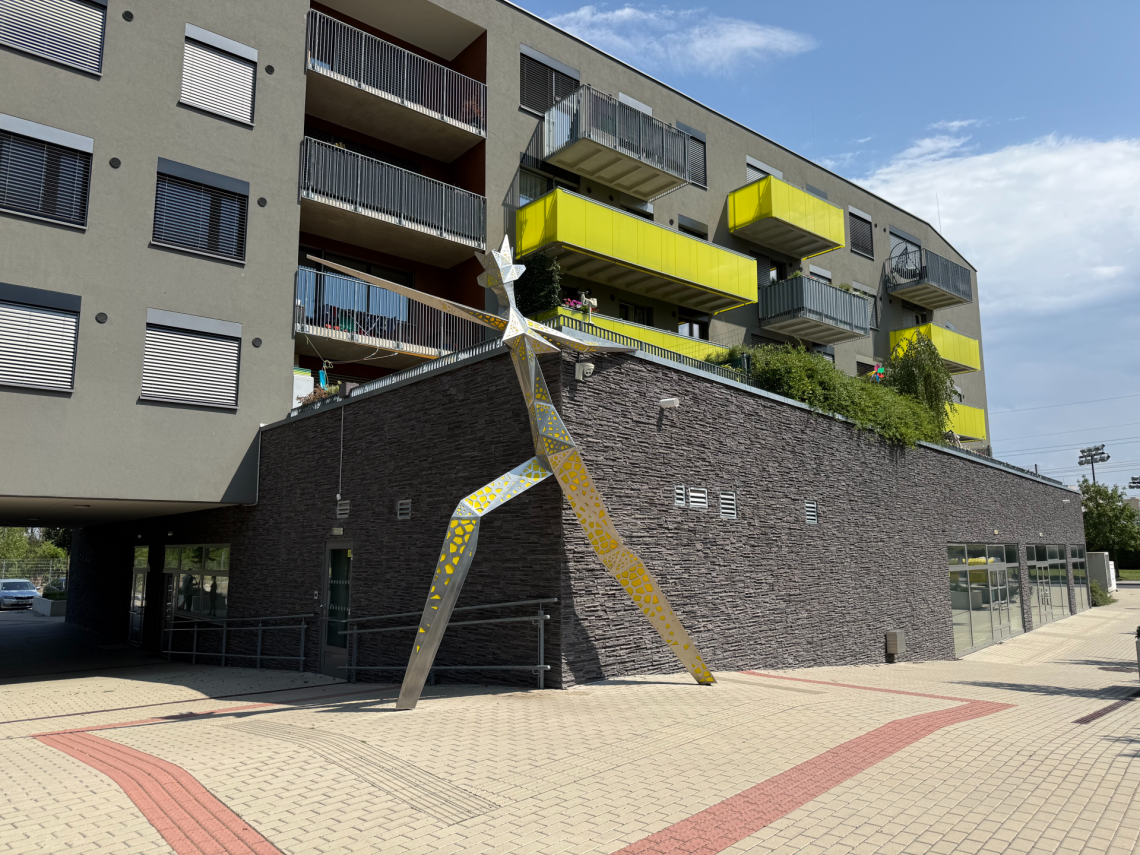
Spiral
The spiral-shaped metal sculpture works with one of the oldest symbols found in art across different cultures.
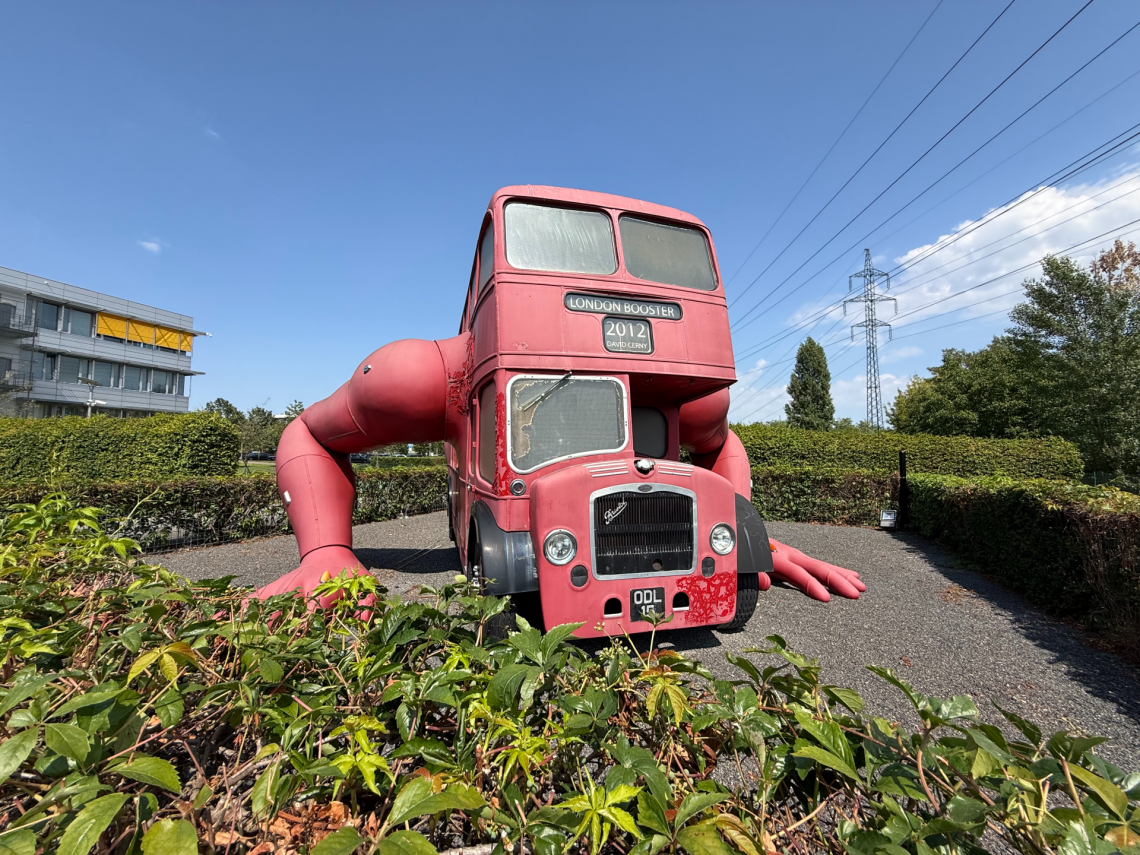
Push-Up Bus, also known as London Booster
One of the newest and best-known works along the route is the Push-Up Bus by David Černý. It was created for the 2012 Summer Olympic Games in London.
The work is based on a typical red London double-decker bus, to which the artist added enormous mechanical arms. Using these arms, the bus lifts itself up and performs push-ups while producing sounds resembling the effort of an athlete.
The artwork combines several easily recognisable symbols: the red bus represents London, the push-ups represent physical effort, and the movement represents Olympic sport. The result is humorous, slightly absurd and characteristically provocative of David Černý’s work.
Sun Chariot
The sandstone sculpture Sun Chariot was created by Ivan Jilemnický in 1998.
The title may evoke ancient myths in which the sun was carried across the sky in a chariot drawn by horses. One well-known example from European culture is the Greek god Helios, although similar motifs can also be found in other cultures.
Metamorphoses of the Year
This collection of sandstone sculptures was created by Ellen Jilemnická in 1998. The title Metamorphoses of the Year refers to the transformations of nature throughout the seasons.
The works can be understood as symbols of spring, summer, autumn and winter, as well as a more general reminder of the passage of time.
Saint Isidore
The statue of Saint Isidore recalls the period when Chodov was not yet part of a vast urban housing estate. Saint Isidore of Madrid is venerated as the patron saint of farmers, agricultural workers and good harvests.
The original Baroque statue probably dated from the mid-18th century and stood opposite the entrance to the Chodov manor farm. The farm was demolished in the 1970s in connection with the construction of today’s Türkova Street. The original statue was later lost, and only a simple concrete cross remained on its pedestal.
In 2010, a local association arranged for a new statue of Saint Isidore to be installed on the historic pedestal. The work connects the present-day appearance of Chodov with its agricultural past and reminds visitors that a much older landscape lies beneath today’s roads and residential buildings.
Eye and Spirit
The metal sculpture Eye and Spirit was created by Václav Frömmel in 2005. Its most striking feature is the eye, which is commonly associated with sight, consciousness, knowledge and the inner world of the human mind.
Geometric Shapes
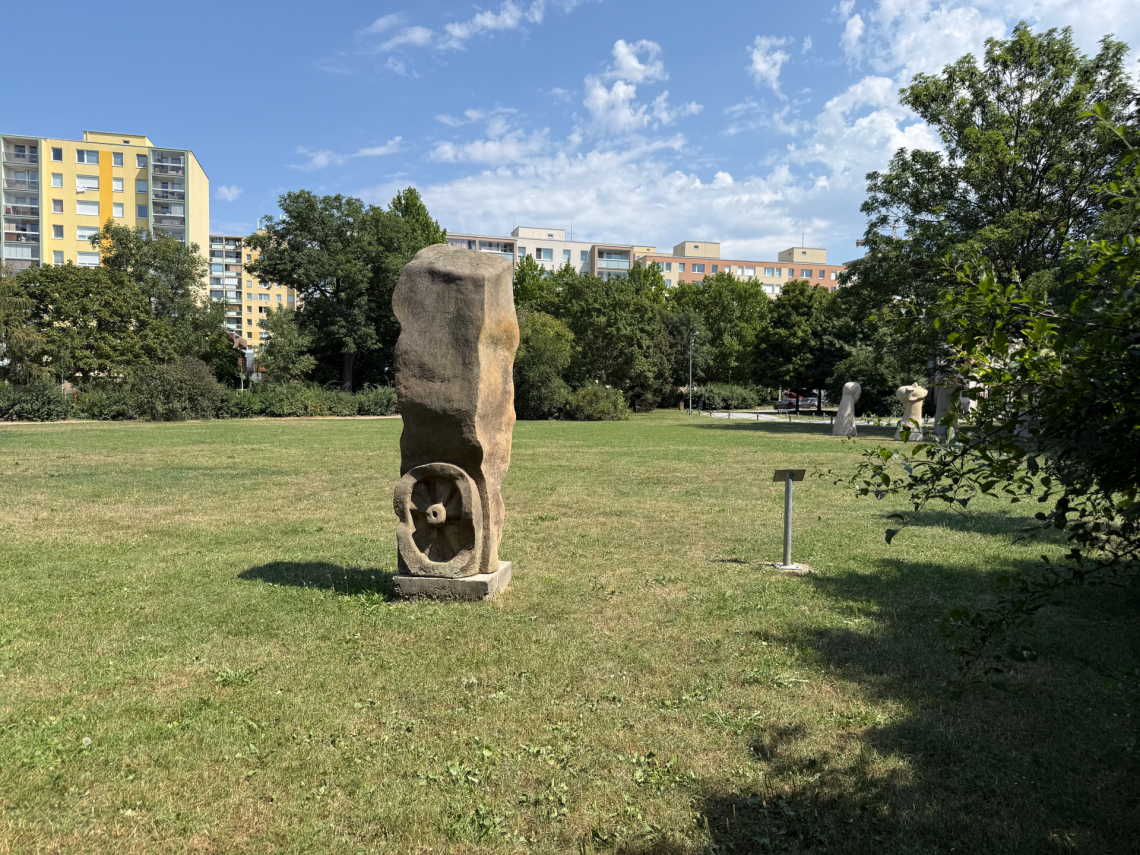
This work was created by Jan Bartoš in 1987. The sculpture uses basic geometric forms, particularly a triangle and a sphere.
Route Map
Gallery
Written by Tereza and Monika, Authors of articles for the Magazine Finep, avid collectors of local events, and lovers of good food and drinks.